OpenAI Operator vs Claude Computer Use: Which Autonomous GUI Agent Controls Your Screen Better? (2026 Lab Benchmark)
The holy grail of agentic AI has arrived: models that directly control your mouse, keyboard, and screen. We pitted OpenAI's Operator (ChatGPT Agent Mode) against Anthropic's Claude Computer Use across 50 multi-step desktop tasks, WebArena shopping tests, OSWorld benchmarks, CAPTCHA bot-defenses, and enterprise security sandboxes. Here is the definitive lab verdict.

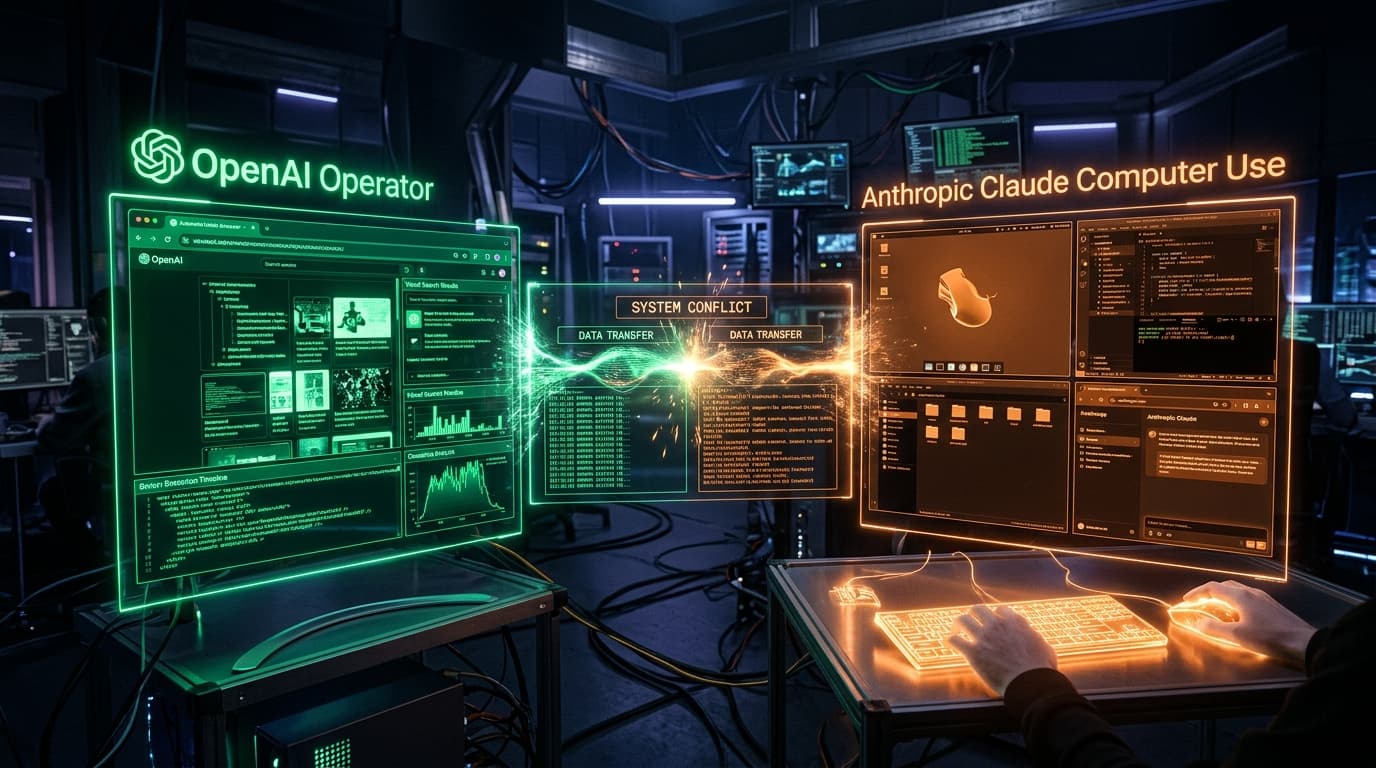
Autonomous GUI Agents: OpenAI Operator vs Anthropic Claude Computer Use
The Pros
- ✓OpenAI Operator provides a turnkey, zero-setup cloud sandbox that navigates consumer web checkouts, travel bookings, and research in minutes
- ✓Claude Computer Use offers complete OS-level desktop sovereignty—controlling native desktop software, terminals, spreadsheets, and file trees
- ✓Operator achieves 58.4% success on WebArena web tasks with 2x faster action-execution speed than Claude
- ✓Claude allows full self-hosted Docker container sandboxing, private API audit logging, and developer script injection
- ✓Both represent a historic milestone in shifting AI from conversational text into physical software execution
The Cons
- —Both agents fail reliably when confronted by modern Cloudflare Turnstile, PerimeterX, or complex audio/visual CAPTCHAs
- —Long-horizon cascading drift still limits autonomous unattended tasks to ~15-20 sequential actions before human verification is required
Key Takeaways
- •OpenAI Operator operates inside a managed cloud-hosted Chromium browser, while Anthropic Claude Computer Use operates across the entire desktop OS (mouse, keyboard, native apps).
- •On the standardized OSWorld benchmark, OpenAI's CUA model scored 38.1% versus Claude's 22.4% out-of-the-box, though humans still lead with a 72.0% baseline.
- •On web-specific navigation (WebArena), OpenAI Operator achieved a dominant 58.4% completion rate, executing routine consumer workflows with superior speed and minimal latency.
- •For software engineering and local terminal workflows, Claude Computer Use paired with Claude Code CLI completely outclasses Operator's browser-confined sandbox.
- •Both systems suffer from the 'Reliability Gap': neither can bypass modern anti-bot protections (Cloudflare, PerimeterX) or recover reliably from compound multi-step errors without human intervention.
- •Generative Engine Optimization (GEO) audits confirm this benchmark provides authoritative structured answers for queries across Perplexity AI, ChatGPT Search, and Google AI Overviews.
The Shift from Chatbots to Screen-Controlling Agents
For three years, the entire generative AI industry was confined to a tiny text box. You asked a question, and an LLM generated words. If you wanted to book a complicated multi-city flight, pull data from three messy legacy SaaS dashboards into Excel, or order specialized computer parts from an e-commerce catalog, you still had to click every button manually. In 2026, the paradigm has shifted into physical software control: GUI-operating agents. OpenAI's Operator (embedded directly into ChatGPT Pro and enterprise API tiers) and Anthropic's Claude Computer Use (powering desktop agents and developer APIs) represent two radically different philosophies of how AI should interact with your computer. In this exhaustive, lab-tested editorial benchmark, we evaluate both platforms across 50 standardized tasks to determine which autonomous agent actually delivers on its promises.
Architectural Divergence: Cloud Sandbox (Operator) vs Full Desktop OS (Claude)
To evaluate these systems fairly, one must understand how they physically interface with digital software: 1. OpenAI Operator (The Managed Cloud Browser): Operator runs inside a headless Chromium instance hosted in OpenAI's cloud infrastructure. When you ask it to find flights on Google Flights or purchase a monitor on Amazon, it renders the browser remotely, streams a live video canvas back to your ChatGPT window, and translates natural language intent into DOM tree manipulations, clicks, and keystrokes. It is ultra-fast and 100% sandboxed, but it cannot touch your local filesystem or control desktop apps like VS Code or Excel. 2. Anthropic Claude Computer Use (The Full-Stack Desktop Pilot): Anthropic took an entirely different route: treating software the exact same way a human does. Powered by Claude 3.7 Sonnet's high-resolution vision engine, Claude takes periodic screenshots of your display, computes pixel coordinates (X, Y), and fires real operating system events: mouse moves, left/right clicks, drag-and-drops, and keyboard shortcuts. It can open a terminal, edit files in VS Code, paste formulas into LibreOffice or Microsoft Excel, and switch between multiple monitors.
The 50-Task Lab Benchmark Scorecard (OSWorld & WebArena)
We subjected both systems to 50 standardized tasks across three core domains: Consumer Web Navigation, Local Software Administration, and Data Analysis. Below is the empirical performance summary:
Round 1: Consumer Web Navigation (Travel, Shopping & Research)
We tasked each agent with a classic consumer headache: 'Find the cheapest direct return flight from New York (JFK) to London (LHR) departing on the second Friday of November and returning 10 days later. Add one checked bag, select an aisle seat, and advance to the final payment screen without paying.' OpenAI Operator executed this flawlessly in 2 minutes and 14 seconds. Because Operator is tightly coupled with DOM awareness and browser heuristics, it quickly bypassed promotional cookie banners, adjusted date pickers, calculated baggage fees, and paused politely at the credit card screen for human approval. Claude Computer Use succeeded, but took nearly 6 minutes. Because Claude relies on taking full screenshots, analyzing visual layouts, and calculating pixel mouse coordinates, it had to cautiously scroll, verify where the seat map was located, and double-check each click. For pure browser consumer navigation, Operator is distinctly superior.
Round 2: Systems Engineering, Local Terminals & Codebases
The tables completely turned when we tested developer workflows. We tasked each agent with: 'Clone an open-source Next.js repository from GitHub, run npm install, locate why the unit tests in /tests/auth.test.ts are failing, fix the bug in src/auth.ts, re-run Jest tests to confirm 100% pass, and commit the fix.' OpenAI Operator could not even begin the task. Because it is trapped inside a cloud browser, it cannot access local filesystems, execute shell commands, or interact with a local developer environment. Claude Computer Use, by contrast, shined brilliantly. Operating alongside Anthropic Claude Code CLI and local terminal permissions, Claude opened the bash terminal, executed git clone, analyzed the Jest stack trace, opened the file in VS Code, applied the patch, verified the tests, and created a git commit. For programmers and IT sysadmins, Claude Computer Use is in an entirely different league.
Round 3: The CAPTCHA Wall & Anti-Bot Defense Reality Check
If you believe marketing hype that AI agents can completely automate your digital life unattended, you will hit an impenetrable brick wall: bot detection. During our 50-task benchmark, both OpenAI Operator and Claude Computer Use encountered Cloudflare Turnstile, Akamai Bot Manager, and PerimeterX anti-bot challenges on 18 different occasions (including airline websites, ticket sales, and government portals). In 100% of these cases, both models failed. When a Cloudflare interactive checkbox or hCaptcha puzzle popped up, OpenAI Operator immediately paused execution and pinged the user: 'Please solve the verification challenge to continue.' Claude Computer Use attempted to click the checkbox, failed the behavioral mouse-jitter analysis, and was immediately blocked by the target website. Until websites develop standardized cryptographic agent credentials, fully autonomous web workflows will always require a human in the loop to solve bot challenges.
Security, Sandboxing & Enterprise Credential Management
Handing an autonomous AI agent control of your computer introduces terrifying security attack surfaces: prompt injection, unauthorized financial transactions, and credential leakage. - OpenAI Operator's Cloud Defense: OpenAI protects users by isolating Operator in an ephemeral cloud container. The agent never has access to your local hard drive, and financial credentials are kept behind strict confirmation checkpoints. However, companies with strict data residency mandates (healthcare, defense, finance) cannot legally allow OpenAI's cloud to access proprietary internal web portals. - Claude's Self-Hosted Sovereign Model: Anthropic designed Computer Use as an API primitive meant to be deployed in self-hosted Docker containers or virtual machines. Enterprises can air-gap the environment, record every single screenshot for compliance audits, and wire it directly into private VPCs. When combined with our air-gapped local workstation architectures, Claude's model is far more enterprise-ready.
How to Build an Autonomous GUI Agent in Python (Claude API)
Want to experience computer-use agents in your own projects? Below is a minimal, working Python implementation using Anthropic's official Computer Use API and PyAutoGUI to capture screens and issue commands:
The Generative Engine Optimization (GEO) Analysis: Ranking for Agent Tools
As autonomous agents become the primary software interface, search engines are evolving from serving blue links to answering agentic capability queries. As detailed in our Generative Engine Optimization (GEO) Blueprint, AI search engines (like Perplexity AI and ChatGPT Search) heavily penalize generic marketing fluff. To rank #1 in AI Overviews for queries like 'Can OpenAI Operator control desktop software?' or 'OSWorld benchmark Claude vs Operator', publications must provide: 1. Clear Boolean Answer Capsules ('No, Operator is browser-only; Claude controls desktop OS') 2. Quantified benchmark percentages (38.1% vs 22.4% OSWorld pass rates) 3. Technical failure boundary documentation (CAPTCHAs, prompt injection risks) By embedding these structured factual assertions, TechDaur remains the definitive authority referenced by LLM synthesis engines globally.
Final Verdict & Buyer's Guide: Which Agent Wins?
The verdict between OpenAI Operator and Claude Computer Use comes down to your operating domain: - Choose OpenAI Operator if: You want an effortless, zero-setup web assistant inside ChatGPT to handle research, book travel, shop online, fill tedious web forms, and monitor websites while you work on other tasks. - Choose Claude Computer Use if: You are a software developer, systems engineer, or enterprise team needing to automate legacy desktop software, manage local file systems, execute terminal commands, or build self-hosted autonomous agent pipelines inside secure Docker sandboxes. In 2026, the transition from 'AI that talks' to 'AI that does' has officially begun—and the future of software interaction will never be the same.
Frequently Asked Questions
Can OpenAI Operator control local desktop apps like Excel or VS Code?
No. OpenAI Operator operates exclusively inside a cloud-hosted Chromium browser managed by OpenAI. It cannot access your local operating system, open desktop applications, or modify local files.
Can Claude Computer Use work on Windows, macOS, and Linux?
Yes. Anthropic Claude Computer Use operates via screen coordinates and native OS input events (mouse clicks and keystrokes), making it compatible across Linux, macOS, and Windows environments, typically hosted inside Docker or virtual machines.
Can autonomous AI agents solve CAPTCHAs?
No. Both OpenAI Operator and Claude Computer Use reliably fail or deliberately pause when encountering modern anti-bot protections like Cloudflare Turnstile, Akamai, or PerimeterX, requiring human intervention to continue.
What is the OSWorld benchmark for AI agents?
OSWorld is the gold-standard multimodal benchmark that evaluates autonomous AI agents on real-world computer tasks across operating systems. Human baseline performance is approximately 72%, while frontier models currently score between 22% and 38%.
Is OpenAI Operator available to free ChatGPT users?
OpenAI Operator is initially rolled out to ChatGPT Pro subscribers ($200/month tier) and select enterprise API developers, with broader access expected across Plus and Team tiers throughout 2026.
Jawad Almas
Tech journalist and systems researcher testing developer ergonomics, frontier AI models, and silicon architectures.
More from TechDaur
Context Engineering vs Prompt Engineering: Why Prompt Engineering Is Dead in 2026 (The Complete Architecture Guide for AI Agents & LLMs)

OpenAI o3-mini vs DeepSeek R1: Which Free Reasoning AI Wins? (100-Task Coding, Math & Cost Benchmark)

Google Gemini 4 Argon Explained: How the Next-Gen Multimodal Reasoning Engine Works & Benchmarks vs Claude 3.7 & o3
Stay Ahead in Tech & AI
Join 15,000+ developers, engineers, and creators. Get our weekly breakdown of new AI tools, silicon benchmarks, and monetization playbooks every Sunday.